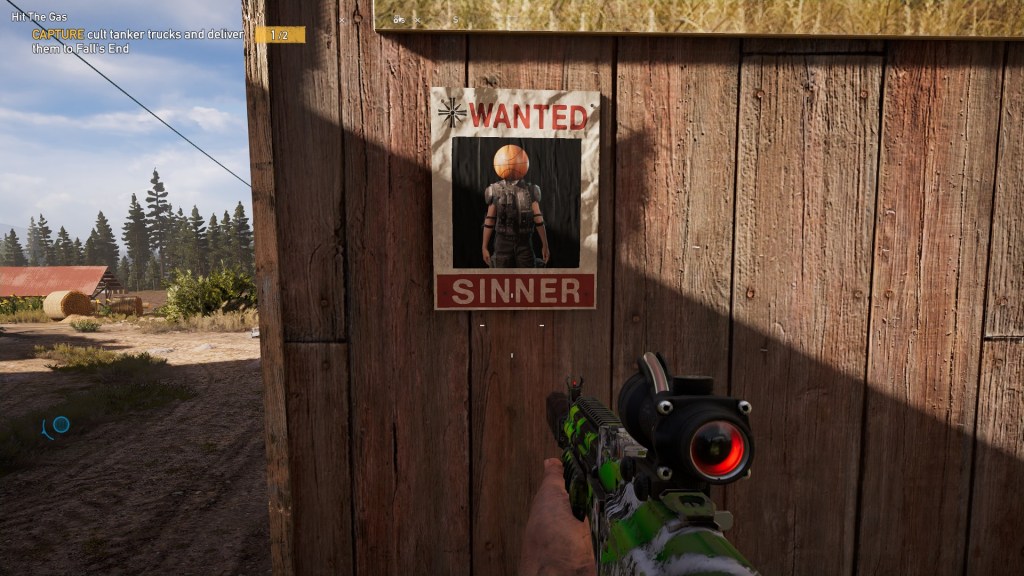
The first time I played any game in the Far Cry series was while I was doing a Master’s thesis on post apocalyptic games from an ecocritical perspective. It was Far Cry: New Dawn and I found myself wracked with guilt every time I killed an animal. Even harvesting flowers was a nightmare as suddenly I was endangering the habitats of the hummingbirds and other pollinators who hovered around them.
Now I am five years into my PhD thesis on the ecogothic and I have turned into an ecological monster, killing and skinning creatures left right and centre. Yesterday I exploded four gas tankers and got an achievement (and sweet sweet perk points) for skinning wolverines. I have become everything I despise, and I blame Ubisoft. So what changed?
I probably need to give some quick theoretical context
Gerald Farca posed the idea of the emancipated player which is the player who is aware of the implications of their actions and viewing their in-game actions critically. So a video game scholar, or a games journalist, a certain type of detail orientated player and an overthinker. I tick most of those boxes. This means that I’m so much fun to play video games with. Who doesn’t want to hear about the implications of unchecked resource extraction while they are trying to make a creeper proof house in Minecraft?
One of the ways I need to analyse the environment is through an environmental lens. So what are these games saying about the environment, what practices are they promoting that effect ecologies and what fears about Nature are they manifesting. For example, Alenda Chang uses the example of Will Wright setting the world on fire in a promotional event for the video game Spore. This shows a particular level of apathy towards a fictional environment which could have implications for a player’s interactions with our world.
Another important piece of theoretical context you need is Tanya Krzywinska’s Gamification of Gothic Coordinates that establishes that failure and vulnerability are key to the Gothic in video games. And as I am dealing with the ecogothic, 90% of my gameplay over the past five years has been adhering to these principles. The player-character is often flawed and not particularly likeable, or they are forced to make awful choices and suffer terrible fates. Basically the type of games I love. They require attention to the story and studying the implications of the treatment of Nature in these video games requires a lot of detail oriented attention.
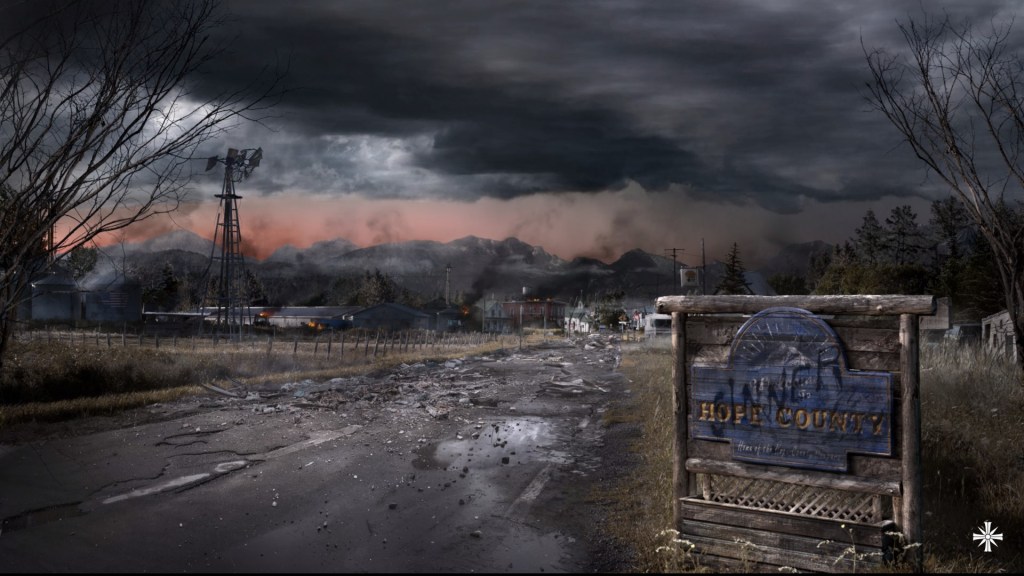
Five years of disempowerment, of nuanced narratives and brain bending puzzles have left me a little emotionally exhausted. I was reading Krzywinska again to check some citation information and I realised that all the video game conventions that made a game not gothic were what I was craving. The power fantasy, the improvement of stats, the almost instant respawn and that wonderful generous checkpoint system. It was time to boot up Far Cry 5 and pay minimal attention to the narrative. No clever world building for me, I will not be engaging with any found documents unless they point me to a prepper stash with oodles of goodies.
I don’t want the inevitable sublimity of death. I want to shoot a cultist through the head with a bow and arrow. I don’t want to rethink and reevaluate the merits of failure in a capitalist system, I want to complete this stealth mission without setting off an alarm so I can get a cash bonus.
Now the person who avoided driving because they felt guilty that their dog had to run to keep up with the vehicle, is letting their dog be burnt to a crisp by a guy with a flame thrower because they are too busy trying to get an assault rifle kill achievement.
What have I become?

References
- Chang, AY 2019, Playing Nature: Ecology in Video Games, University of Minnesota Press, Minneapolis, retrieved April 8, 2022, from <https://muse.jhu.edu/book/72358>.
- Farca, G 2016, ‘The Emancipated Player’, DiGRA/FDG.
- Krzywinska, T 2015, ‘The Gamification of Gothic Coordinates’, Revenant: Critical and Creative Studies of the Supernatural, vol. 1, no. 1, pp. 58–78.
 Morgan Writes
Leave a comment